

Malcolm’s wife Helen was plain. Her name was plain. Good ol’ dependable Helen. The type of girl you marry because she is kind and predictable. A real stand-by-your-man type. But Helen was exhausting. She always needed something. When they first started dating, she neededtosee him every day, needed to hear his voice on the phone, needed him physically. When they got married, she needed the house in the suburbs with the white picket fence and the rolling lawn. Now, tormented by the ticking of her biological clock, she had decided that she needed children, a boy and a girl. That was all he had heard for months: a boy and a girl, a boy and a girl, a boy and a girl… Malcolm stewed in silent fury–he had never wanted children and had told Helen that before they married.
Children–the thought made him shudder. Children with their red faces and their tiny, dirty hands and their squalling cries at all hours of the night. Children with their play dates and trips to the beach where they would get sunburned or eat sand or, god forbid, be washed out to sea. He would not resign himself to soccer vans and piles of endless laundry and fast-food restaurants with their ball pits that smelled faintly of urine. He would not argue about it with Helen; when she got an idea stuck in her head, it would not be easily dislodged.
So he got a vasectomy. He was in and out of the doctor’s office in an hour. He would tell Helen about it…eventually. For now, he would continue to play his role in the game. He would avoid hot baths, he would bulk order ovulation test strips, and he would have frequent intercourse with Helen. Intercourse, not sex, because it had become a mostly mechanical act, undertaken only for its intended biological outcome: offspring. He hated the way Helen would cross her legs and prop them up on the wall after intercourse “to increase the chance of fertilization.” She appeared to Malcolm like an inverted Buddha, which made the whole thing seem even more unnatural and ungodly. A boy and a girl! Like ordering bookends from a home shopping channel. Want a boy? If you order in the next half hour, we’ll throw in a girl at no extra charge!
Malcolm smoothed down an errant hair and reached for the bouquet of flowers on the passenger’s seat. He walked up to the bungalow and then suddenly remembered. He turned off his cell phone and then removed his wedding ring, slipping it into his pants pocket. Cassandra wouldn’t like that. Perhaps she suspected that Malcolm was married, but it would be a little on the nose, a little gauche, to rub it in her face.
We all have our assigned roles, Malcolm thought to himself. Today I am playing the gentleman caller, not the cheating husband.
He rang the doorbell and waited. He rang it again. A small boy with dark eyes and horn-rimmed glasses opened the door. Her son! Malcolm had almost managed to forget about him. What was his name?
Cassandra appeared and placed her hands supportively on her son’s shoulders. “William, you remember Malcolm, don’t you?”
The boy shrugged.
“That’s okay, William,” Malcolm gushed, “I couldn’t forget you!”
Malcolm was terrible with children, which was part of the reason he never wanted any. He could never tell what age they were supposed to be–four or six or eight–so he never knew whether to pinch their cheeks or ruffle their hair or give them a high five. Malcolm smiled at William. William stared back at him like a myopic owl. He didn’t look like a child at all but like an adult–an austere and humorless adult who worked as an almond grader or tollbooth operator and had somehow become trapped in a child’s body. Malcolm just knew the child would never have a friend or an easy rapport with anyone. He would never be a Will or Bill or Billy but was destined to remain a William–quiet, odd, friendless William.
“Are these for me?” Cassandra asked, reaching for the flowers.
No, you stupid woman, I bought them for William. The thought bubbled forward, but Malcolm suppressed it with a smile.
“How lovely!” Cassandra clutched the bouquet and inhaled deeply. “They smell amazing,” she cooed. “You shouldn’t have!”
Malcolm smiled again. He knew the flowers smelled like nothing at all. The bouquet had hydrangeas, ranunculus, snapdragons, and tulips–all flowers with no scent–because of Helen’s allergies. He had given her the bouquet two days ago as an early anniversary present. When he thought of it now, the flowers were a perfect visual representation of their marriage–initially striking but without essence or zest. The flowers had played their part in the analogy and had begun to droop and wilt prematurely. Helen had asked him to throw them out, but he knew that Cassandra would appreciate them.
Cassandra threw her arms around Malcolm and kissed his cheek with a theatrical “Mwah!” He could feel the warmth of her, her soft feminine curves. He suddenly had an urgent desire for her.
“Down, boy,” she chided with a playful smile. “Can I get you boys something to drink? William likes milk, but I’m sure you’d prefer something stronger, Malcolm?”
“I could always do with a stiff drink, Cassandra,” Malcolm replied.
She laughed as she headed to the kitchen. It was that part of the courtship. The part with the double entendres and knowing winks and sex that came frequently and with an urgency and passion that would never be matched.
Malcolm smiled dreamily to himself. He noticed William sitting on the sofa staring at him. “Hello, William.”
William said nothing. His eyes blinked once. Twice.
“You don’t talk much, do you? It’s better that way. You get yourself into less trouble.”
William’s tiny hand opened and closed. It looked like a squid swimming.
“What have you got there, sport?”
William opened his palm, and in the center of it was a pearlescent blue marble.
Malcolm picked up the marble, turned it over in his hand, and gave it back to the boy. “Very nice, William. Is that the only one you have? Did you lose the rest? Did you lose your marbles?” Malcolm smiled at his own cleverness and rested a hand on the boy’s knee. “I don’t think you like me very much, William, but that’s okay. I’m not going to be coming around much anymore.”
Malcolm could see the faintest flutter at William’s nostrils, the slightest suggestion of life. Otherwise, he might as well have been talking to a doll.
“Maybe you wonder why I come here at all? Well, I’ll tell you. I come here to fuck your mother.”
Malcolm fancied that the boy’s eyes grew a fraction larger.
“Oh, I’m sorry, William. I didn’t mean to offend your delicate sensibilities. I come here to make love to your mother.” Malcolm smiled at the boy. “Do you want to know the difference between making love and fucking?”
The boy said nothing.
“Well, William, your mother is making love to me while I’m fucking her!” Malcolm laughed.
“Good to hear you boys are getting along,” Cassandra said as she entered the room. She set down a cup of milk next to William and handed Malcolm a tumbler of amber liquid, the glass tinkling with ice. “How’s that?” she asked Malcolm.
He took a sip. It tasted like banana bread and bourbon barrels, rising smoke and honey. “That’s delicious. What is it?”
Cassandra brushed a hair from Malcolm’s face. “Stick around long enough and I might tell you.”
She probably imagined that it was a harmless remark, but Malcolm recognized the desperation in it. The fear of being forgotten, left behind, supplanted by someone new. He knew their relationship would have to end soon. These things ran a natural course. But they still had today, they still had this afternoon, they still had…William.
“Do you want to put some shows on for the kid so we can go to your room and”–Malcolm grinned–“talk?”
Cassandra nodded. “Hmmm…talk…yeah. When have we ever just talked?”
Never. The answer was never. They did talk, but only afterwards. When they were slick with sweat and buzzing with post-coital endorphins. Talked about fast food and high school and animals they liked and actors they didn’t and heaven and hell and everything and nothing. The rambling, inane, inconsequential stream-of-consciousness dialogue between two completely loved-up people. Fat on love, fat as Piccadilly pigeons.
“William, honey, do you want to watch some cartoons?” Cassandra skimmed through the channels. “SpongeBob? You like SpongeBob. Okay, honey? Mommy and Malcolm are going to go talk for a bit. We’ll be right back.”
She kissed William’s head and led Malcolm to the bedroom, closing the door behind her. Now they were stumbling, falling over one another. Two creatures joined at the mouth, fumbling at each other’s clothes. Cassandra fell backward onto the bed. Malcolm threw his shirt on the floor. His pants were halfway down, and he fell on top of her. Cassandra laughed, and the afternoon was theirs.
Malcolm woke to the smell of frying onions and garlic. He climbed woozily out of bed. Sleeping at any time other than night always made him feel this way–punch drunk, with a head full of fog. He put on his shirt, then his pants, one unsteady leg at a time. He followed the smell to the kitchen. Cassandra was there in a thin t-shirt and gym shorts. Cassandra–messy, casual, and perfect–so different from Helen. When Helen cooked, she always tied her hair back and wore an apron like some hausfrau from a fifties catalog.
“Hi, sleepyhead,” Cassandra chirped.
“What time is it?”
Cassandra looked at her phone. “Quarter after six.”
“Shit. Shit…”
“What’s wrong?”
“Listen, Cassandra, I have to go.”
“You’re not going to stay for dinner? I’m fixing meatloaf–it’s William’s favorite.”
“I can’t. I have a deadline at work. So much to do. I’m under enormous pressure.”
Cassandra put on a face like an orphan, complete with trembling lip.
“I’d love to, but I can’t.”
“You’ll call me?”
“Of course.”
“When?”
“Soon.”
“Tonight?”
“Soon.”
Men and women really are from different planets, Malcolm thought bitterly as he drove home. Men want flings and dalliances and adventures, and women want relationships, bonds, and commitments. They will tell you otherwise in the beginning. They will tell you how they just got out of a relationship and how they want something casual. No strings attached. But the strings attach. They fasten with every date, every glass of wine, and every roll in the hay. Until you are suspended in space by strings, held up like a puppet with no will of your own. No, thank you!
It always ended up this way. It had been like this with Katherine. Katherine with a K. She wore librarian glasses, and she drank gin and tonics. Her family was rich; her father traded opals. She always cried after sex. “Not because I’m sad. Because I’m happy,” she had assured him. He had never quite believed her.
It had happened this way with Gemma. Gemma with her ribald sense of humor and tattoo of Hot Stuff the Little Devil above her left breast. Malcolm had imagined that sex with her would be the best ever. But she had simply lain beneath him inert and silent.
There had been other women. So many over the years, but he could barely remember them now, only the smallest details. He was almost home. He turned on his cell phone. Plink. A new message. Plink. Plink. Plink. Plink.
“Shit!” Malcolm muttered. Five new messages, all of them from Helen. Had he slipped up? Was it the ol’ lipstick on the collar? Had he been spotted in the wild by one of Helen’s jealous, insufferable friends? Maybe he had carried Cassandra home with him once–the smell of her–on his lips, on his fingertips, and Helen had finally decided to confront him about it. His heart thumped in his chest. He pulled into the drive, straightened his shirt, and popped a mint into his mouth. As he reached into his pocket to retrieve his wedding ring, his practiced smile twisted into a perplexed grimace. It wasn’t the ring. It was a pearlescent blue marble.
The boy held the ring in his hand. It surprised him how heavy it was for its size. He knew that the ring was important, because the man had kept it hidden. William had watched from the window–how the man had slid the ring off of his finger and put it in his pocket. William had taken the ring while the man was sleeping. He knew that stealing was wrong, so he had left his favorite blue marble in its place as a trade. He delighted in the ring, its golden color and the shiny surface where he could just make out the smudge of his own reflection.
Helen was sitting at the kitchen table, her head lowered, staring at something. She trembled with not-quite-noiseless sobs.
“Honey?”
She lifted her head. Her face was puffy and red. Her cheeks glistened with the tracks of dry tears.
“Oh, honey…” Malcolm began.
Helen held up an object. Malcolm’s first thought was that she had discovered some incriminating evidence, but as he looked more closely, he saw what it was: a home pregnancy test. The two telltale strips of a positive result sent a shudder down his body.
Helen sobbed, “Oh, Mal, I’m so happy! I’d almost given up hope.”
“How…” Malcolm stammered, “how wonderful.”
We all have our assigned roles, Malcolm thought to himself. Today I am playing the expectant father, not the cuckolded husband.
“Malcom at Midlife” was published in Adelaide Year V number 40.
https://adelaidebooks.org/adelaide-literary-magazine-no40-year-v-september-2020
“Okay, if you could have any superpower, what would it be?”

“Telepathy, of course,” my mother replied.

“Of course,” I chuckled. “That would make your job easier, huh?”

“How about you?”

“Umm, I think…telepathic euthanasia.”

“Oooh, dark.”

“Yeah. But I would only use it on really bad people–you know, animal abusers, child murderers, evil dictators… Maybe also for people who are suffering from a terminal illness and don’t want to live anymore. It would be quick and painless.”

“I get it, sweetie. I know you’d only use your Dark Phoenix-y powers for good,” my mother assured me with a smile.

We were killing time while we volunteered at the local community market. Every Saturday in the summer, my mother ran a stall selling t-shirts on behalf of the Summit Hill Psychiatric Hospital, and my grandmother and I took turns helping her. In the center of the table was a little placard that read, “Created by the patients of the Summit Hill Psychiatric Hospital, each one unique!” That just seemed deliberately ambiguous–did they mean the t-shirts or the patients? Sometimes I’d peer at those gaudy tie-dyes, arranged on the table in layer upon lurid layer, and try to imagine the people who had created them.

It was almost noon, and the smell of homemade soap now had to compete with the smell of frying food. My mother was trying to rustle up sales by channeling a strange combination of carnival barker and used car salesman. I went off on my usual circuit around the market to browse the stalls and pick up some falafel sandwiches for lunch. As I was heading back, I noticed a table piled with hardcover books whose ornate gold lettering caught the sun and winked at me–like coins in the bottom of a well. The woman sitting at the table was small and thin, wore dark glasses, and cooled herself with a Chinese fan. She caught me staring at her and raised her hand a little. I returned a small smile.

“Mom, who is that woman?”

“Which one?” my mother mumbled through a mouthful of falafel.

“That sad-looking one,” I replied, pointing toward the stall.

My mother slid her sunglasses down the bridge of her nose and squinted. “Oh god,” she said, “I think that’s Victoria Sloan!”

“Who?”

“Victoria Sloan, the romance novelist. She was huge in the 80s. I read recently that she was doing a book tour for her autobiography, but I never expected this!” My mother wiped the side of her mouth with a napkin. “What do you know about the 80s?”

“Not much. Just the music, since you play it all the time. Oh, and that horrible movie that you made me watch. The one where the horse dies.”

“The Neverending Story.”

“That’s it. Horrible movie. Psychologically scarring. Really mother, you should know better!”

“You turned out okay,” my mother retorted. “Anyway, the 80s was a time of immense materialism and narcissism. Dynasty, Dallas, Lifestyles of the Rich and Famous…TV was like a love letter to capitalism, and the romance novelists of the day followed suit.” She crumpled up her sandwich wrapper and tossed it in the trash. “Jackie Collins, Danielle Steele, and Victoria Sloan were the big three. They were always on the bestseller list, which was odd because no one would ever admit to reading their books. I liked Victoria Sloan the best, because although she followed the trend, she did things a bit differently. In Days of Love, one of the main characters, Foster Cabbott, is in a coma. Now, you hear about Foster all the time, how handsome he is, how charming, how incredibly wealthy and powerful. You spend the entire book expecting him to wake up. He never does! It’s all very meta, very Waiting for Godot, and for an 80s romance novel, it completely defied convention.”

“She sounds pretty cool.”

“She was pretty cool.” My mother glanced at Victoria Sloan. “You’re right, she does look awfully sad. You should go and ask for her autograph.”

“Mom, you know I don’t do well with famous people.”

“Puh! You didn’t even know who she was until a minute ago.”

“Yeah, but now I do. You know how awkward I get. Remember John Goodman?”

My mother snorted. “How could I forget?”

Once when we were sightseeing in New York City, we saw John Goodman waiting at a crosswalk. My mother nudged my arm. As he walked away, I shouted after him, “I loved you in Cheers!” Mom patted me on the shoulder. “Nice work, baby doll, but he was in Roseanne, not Cheers.” I recalled the shameful heat that rose up in my body as I prayed that he would not turn around. If he had, I might just have spontaneously combusted.

It was fun to observe Victoria Sloan covertly. There was a tall, joyless-looking woman with her who brought her drinks and occasionally bent down to whisper in her ear.

“She is,” I mused, “an android created only to serve. She has no free will, only directives she must follow–programming.”

My mother giggled. “You would think they would have programmed her to use a hand fan. Poor Victoria has had to do it herself this whole time!”

I took a sip of soda. “She’s an Andalusian shepherdess, and Victoria Sloan saved her life, so now she is bound in servitude.”

“Oh dear, it looks like your shepherdess is getting ready to clear out.” The large woman was gathering the books and packing them into cardboard boxes.

“Oh man, there goes our fun,” I sighed. “It’s weird–I do feel like I should go up to her and say something. But, seriously, what would I say?”

“Just say you’re a fan. And tell her you want to be a writer too–that part’s true, at least.”

“Okay.” I took the sort of deep breath you take before you dive underwater and walked over to the stall. Victoria Sloan’s back was turned. I thought briefly of tapping her on the shoulder, but I had a vision of the Andalusian shepherdess jumping forth and snapping my wrist.

“Mrs.…Mrs. Sloan?” I stammered.

“It’s Ms.,” she corrected as she turned around.

“I…I…just wanted to say that I’m a fan of your work.”

“Oh, really?” A hesitant smile spread over her face. “And which is your favorite?”

“My favorite? Well, I… My favorite is Days of Love. I like the way it defies the conventions of the time. I’m an aspiring writer, and I’d love to be able to write something that original someday.”

“Ah, you’re a sweet girl. What’s your name?”

“Meg.”

She removed a pen from her handbag and picked up one of the remaining books on the table.

“Oh, no, that’s not what I… I don’t have any money on me.”

She smiled and handed me the book. “It’s a gift.”

                                     *

“This is the last time, Mom. You know I get sick reading in the car.

Sweet Meg,
Keep smiling, kitten. You can do anything you put your mind to.
Best Wishes,
Victoria Sloan”

“I just love that she wrote kitten,” my mother sighed. “Aren’t you glad you talked to her?”

“Yes, Mom.”

“I bet she had one of those transatlantic accents, that old Hollywood way of speaking?”

“I didn’t notice–I was too nervous.” The book rested on my lap. There was something really reassuring about its bulk. “I can’t wait to get out of high school and start taking some real writing classes.”

“I know, honey, but I really think you should consider doing some travelling before college. Take a gap year like I did. It made all the difference for me.”

“I don’t know...”

“The thing about travelling is you learn a little about the world and a lot about yourself. I think it would be good for you–and your writing.”

“Maybe if I don’t get into one of my top choices…”

“Italy changed my life. Did I tell you that when I was in Viterbo, I snuck into the Gardens of Bomarzo at night?”

I shook my head.

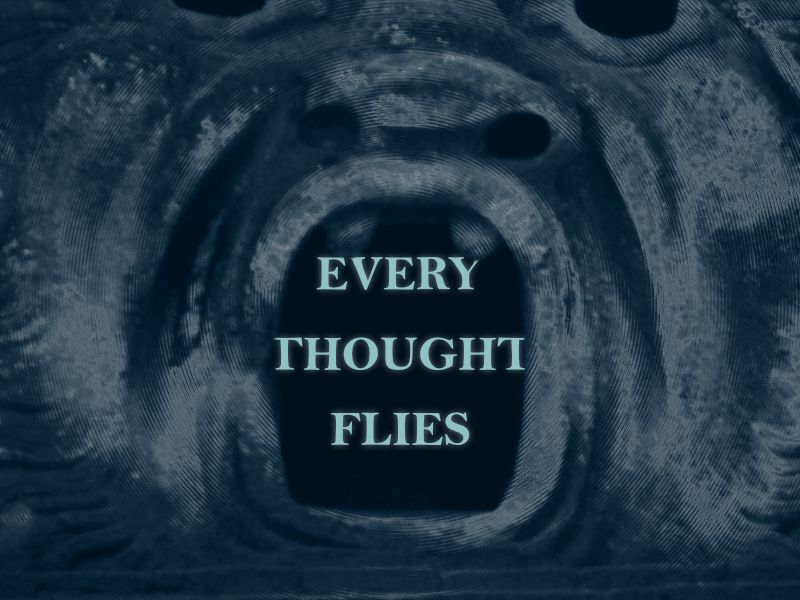
“They were built in the sixteenth century and are filled with these grotesque sculptures of dragons and giants and women with wings. It was like walking in a dream. The centerpiece of the gardens is the Mouth of Orcus. You walk up these ancient stone steps and into this massive mouth. The size and shape of the mouth give it peculiar acoustic properties. You’re supposed to be able to hear people inside it whispering from beyond the steps, but I was alone, so I didn’t get to experience that. I did think that I could hear my own footsteps coming toward me, though. It felt as if I was about to be greeted by my own self, but the sound always disappeared before the footsteps reached me.”

“Weren’t you creeped out?”

“I wasn’t, actually. I felt strangely calm, as though I had been waiting all my life for that moment. Above the Orcus Mouth, there is an inscription–ogni pensiero vola: every thought flies. Those words resonated with me because I’d been thinking of studying psychology. The whole experience seemed like a good omen.”  My mother continued, “I’m not saying that if you travel you’ll have a similar epiphany, but you might… Anyway, enough of that for now. Are you up for a game of musical roulette?”

I laughed. “Of course I am.”

Musical roulette was our way of democratizing the music we listened to in the car. On the playlist were 50 of my mother’s favorite songs and 50 of mine. We added an element of chance by playing them on random. My mother liked to regale her friends with the story of the “inexorably long road trip” where almost all of my songs came up.

I pushed play, and the jangly guitars of the Travelling Wilburys’ “Handle with Care” came through the stereo.

“Oh! One of mine!” My mother dialed up the volume.

“Greaaat.” I rolled my eyes. “I don’t hate this song, but the guy who sings the bridge–”

“Roy Orbison.”

“Roy Orbison. Well, he always sounds like he’s on the verge of tears.”

That was the last thing I remembered about that day–Roy Orbison’s mournful voice and then the sound of breaking glass. Blackness came, but it was not absolute. It was blackness and the feeling of being turned over again and again.

                                     *

My grandmother took me to a counselor to help me “process my feelings.” The counselor’s name was Anne Wilkes, and she insisted on being called Annie. Annie Wilkes–the name of the crazy woman in Stephen King’s Misery. Annie had a singsong voice and a little notepad, and she nodded along to everything you said, so the overall impression she gave was that of a waitress taking your order.

“Sometimes we feel a range of emotions–anger, pain, guilt–and we bottle these up inside. You probably learned a lot about this from your mother, but it’s not always easy to apply it to yourself. It helps to talk about your feelings, as we’re doing now,”–she smiled and rested her notepad on her lap–“but there are other things you could do to make these abstract feelings tangible. You could create art or keep a journal. When you feel anger or even guilt…it sounds silly, but you could punch or scream into a pillow.”

Oh, Annie, I didn’t need a journal or a pillow to cry into–I had the Internet. I looked up Adam Warner, the man who drove into us, the man who killed my mother. Adam Warner was drunk and driving on a suspended license when he hit us. I trawled the Internet searching for mug shots; I needed to attach a face to all the pain I felt. The photos were…not what I expected. In the first one I found, he looked almost cherubic with his lopsided grin and sandy brown curls. That picture wouldn’t do at all. In the next photo, his face was drawn, his skin was sallow, and there was the ghost of a bruise under his right eye. Still he smiled, and his smile was warm and wholesome. Finally, I found what I was looking for–his last booking, just three months before the accident. His hair was a mass of greasy coils, his eyes were dull, and his cheerful smirk had become a sneer.

I printed the photo and taped it to the ceiling above my bed. I focused on it every night, poured all of my hate and anger and sadness into it. Every night the whispers rose from my bed like those of a small child reciting her prayers. But these were not prayers; these were the opposite of prayers. Soon I noticed that the image was beginning to change. It was no longer just a photograph–his face had life and light. It was lit from within like a Chinese lantern. It was also no longer eight feet from me–the ceiling had disappeared, and his face was far away, shining like a star. From deep within my mind a tangible thought surfaced. The thought was death. It was like a huge obelisk of black glass rising out of me and radiating with a cold heat. It took all of my concentration, but I began inching the thought obelisk toward that shining star, toward Adam Warner. I knew that if the thought could reach that light, it would extinguish it forever.

The more I practiced the more easily the thought rose out of me. It was almost a physiological action now–the way your throat heaves when you’re about to vomit. The thought was dark and dense and incredibly hard, but it was also brittle, so as it moved through time and space, it would begin to crack and fracture. Shards of black glass would fall as the obelisk moved toward the star. One night, it came within a hundred feet of that glowing face and shattered completely, sending a shower of glittering splinters into the heavens.

                                     *

“Have you considered medication? I have a colleague who could help you.”

I shook my head. “I don’t want drugs. I don’t want anything that would numb me, anything that would dull my senses.”

“Fair enough.” Annie smiled conciliatorily. “There are other, more natural alternatives. Transcendental meditation has helped a great many people with Post Traumatic Stress. It can help you feel calm and centered, lower your blood pressure, focus your thoughts–”

“Focus my thoughts?”

“That’s one of the benefits.”

“You can teach me this meditation?”

“No, but I can refer you to an instructor who teaches a course, and–”

“That would take too long.”

Annie knit her brow. “You would need an instructor. You would need to discover your mantra. You would have to learn to–”

“My mantra?”

“The word or phrase you would repeat over and over again to help with the meditation.”

Thank you, Annie. Thank you.

That night, the ceiling disappeared and Adam Warner’s face beamed down as before. I conjured up the thought again. It pulsed with energy; it was resonant as a bell. I beckoned it. Ogni pensiero vola. It lurched upward. Ogni pensiero vola, ogni pensiero vola, ognipensierovola… I chanted the words over and over until they became one word, repeated ceaselessly. The obelisk moved with intent, shuddering and shaking as it rose. Splinters fell from it, now larger pieces. I wondered if it would hold together long enough to reach the star. It was burning up like a comet, but still it rose. I had imagined that I would smash that face with blunt force, but when at last the obelisk reached Adam Warner, only a single shard remained. The shard was as thin and sharp as an ice pick, and I pressed it against his forehead. It met with resistance. Ogni pensiero vola. The shard thrust into his head, and his eyes widened in a moment of comprehension. The light that had been shining began to dim and then finally disappeared.

                                     *

Annie placed her little notepad on her lap. “I’m sorry to hear that you’ve decided not to continue our sessions.”

“You’ve been great, Annie. Really. I just feel like I’ve gotten what I needed from them.”

“Well,” Annie responded hopefully, “if that’s how you feel…”

“It is. Thank you, though. You’ve helped me more than you can possibly know.”

“Meg, I wasn’t sure if I should bring this up now, but…Adam Warner, the man who was driving the truck that hit you… He died two days ago.”

“Oh,” I replied.

“He was found in bed. It was like he went to sleep and never woke up. They think it was probably a blood clot–from when he broke his legs in the accident.”

“Huh.”

“How does this make you feel?”

“How do I feel?” I raised my eyes toward the ceiling. “I feel…calm, centered…focused.”

Annie nodded, picked up her notepad, and wrote something down.

                                     *

I still feel calm, centered, and focused, and now I know I can do anything I set my mind to. So I’ve decided to take that gap year, to chart my own course. Well, not entirely my own–I’ll be starting my journey in Italy. I’m flying into Rome on Saturday, and from there I’ll take the train north to Viterbo. I’ll go to the Gardens of Bomarzo as my mother did before me. I will ascend those stone steps and enter the mouth of Orcus, and in the darkness I will wait to hear the sound of my own footsteps rising up to meet me.


“Every Thought Flies” was published in The Blue Nib Issue 41.
https://www.amazon.com/Blue-Nib-Literary-Magazine-interviews/dp/1916154573
 kptaylorstories.com